Professional O-Ring and Oil Seal Manufacturer, Sealing Solution Supplier Since 2008.



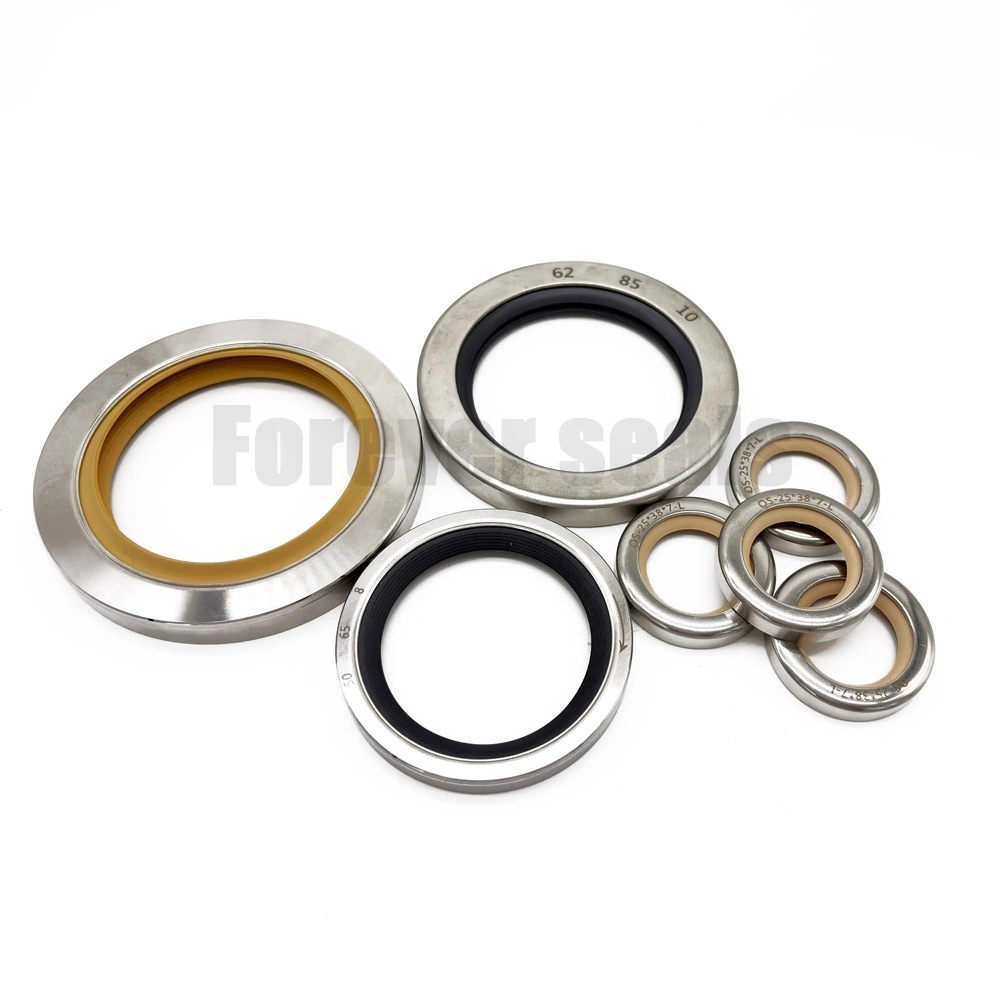
Stainless Steel PTFE Single & Double Lip Rotary Shaft Seal
1. Structure
- Stainless steel casing (skeleton) 304 stainless steel is commonly used; 316 stainless steel is selected for corrosive working conditions. Press-fit into the housing bore to form static sealing on the outer diameter, avoiding rusting and deformation that occurs with carbon steel skeletons.
- PTFE double lips
- Primary lip (inner lip): Faces the fluid chamber for medium sealing. Many designs feature hydrodynamic threads on the lip. When the shaft rotates, the threads pump tiny leaked fluid back into the chamber to achieve active sealing.
- Secondary lip (outer dust lip): Faces outward to block dust, moisture and contaminants, protecting the primary lip.
- PTFE material is usually filled and modified (glass fiber, carbon powder, graphite, molybdenum disulfide) to improve wear resistance. Virgin PTFE is used for food and pharmaceutical applications requiring FDA compliance.
Important note: Conventional PTFE oil seals do not have the garter spring found in rubber oil seals. The sealing force comes from the preloaded geometry of the PTFE lip gripping the shaft.
2. Typical Performance Parameters
- Temperature range: -70 ~ +250°C, much wider than NBR / FKM rubber oil seals
- Shaft surface speed: up to 30~40 m/s, suitable for high-speed shafts (conventional rubber oil seals are limited to 15~20 m/s)
- Working pressure: up to 1~3 MPa. Rubber skeleton oil seals are normally limited to 0.03~0.05 MPa
- Coefficient of friction: very low at approx. 0.02~0.04, self-lubricating. Short dry-running is permissible, while rubber oil seals must never run dry.
- Media compatibility: resistant to oils, synthetic oils, water, acids, alkalis and most solvents. Virgin PTFE grades meet FDA requirements for food & pharmaceutical service.
3. Sealing Principle
- Rubber oil seal: Rely on garter spring + rubber elasticity to grip the shaft and seal passively via a thin lubricating film.
- Stainless steel PTFE double lip seal: The precision interference fit of the PTFE lip contacts the shaft. For threaded versions, shaft rotation creates hydrodynamic pumping effect, actively returning escaping medium back inside the equipment. The double-lip design: inner lip seals the medium, outer lip prevents dust and contamination.
Limitation: PTFE has poor elasticity. It has strict requirements for shaft surface roughness, shaft runout and installation concentricity. The shaft surface must be polished.
4. Advantages
- Wide temperature resistance, chemical resistance, rust-proof housing
- Capable of high speed and higher pressure
- Low friction, low starting torque, less power consumption and heat generation
- Permits short-time dry running; service life can be several times longer than rubber oil seals
- Clean material with no extractables, suitable for food and pharmaceutical equipment
5. Disadvantages (Key for Selection)
- Low elasticity, sensitive to shaft surface quality; scratches on the shaft easily cause leakage
- Poor tolerance to shaft eccentricity and runout
- Much higher cost than NBR / standard FKM rubber oil seals
- Very demanding installation; PTFE lip is extremely vulnerable to damage. Special installation tooling is mandatory.
6. Typical Applications
Screw air compressors, turbochargers, new energy motors, chemical pumps, food & pharmaceutical equipment, vacuum pumps, high-speed gearboxes, gas equipment, compressors.
7. Comparison: Stainless Steel PTFE Double Lip Seal vs TC Rubber Double Lip Oil Seal
| Item | SS PTFE double lip seal | TC rubber double lip oil seal (NBR/FKM) |
|---|---|---|
| Skeleton | 304/316 stainless steel | Cold rolled carbon steel |
| Lip material | Modified PTFE | Nitrile / Fluoro rubber |
| Garter spring | Mostly without spring | With garter spring |
| Temperature | -70 ~ 250°C | -40 ~ 120°C (NBR) |
| Max surface speed | Up to 30~40 m/s | ≤15~20 m/s |
| Working pressure | Up to 1~3 MPa | ≤0.05 MPa |
| Dry running | Short-time dry run acceptable | Dry friction is strictly forbidden |
| Cost | High | Low |
8. Installation Guidelines
- Shaft surface must be free of burrs and scratches with controlled roughness;
- Lip orientation: Primary lip towards the medium chamber, dust lip outwards;
- Use dedicated installation sleeve. Never strike directly;
- Apply a small amount of lubricant to the PTFE lip during assembly;
- Tighter tolerances for housing bore and concentricity compared to rubber oil seals.
Get In Touch With Us
We are committed to meeting the diverse needs of our global customers through innovation and continuous improvement.